Introduction
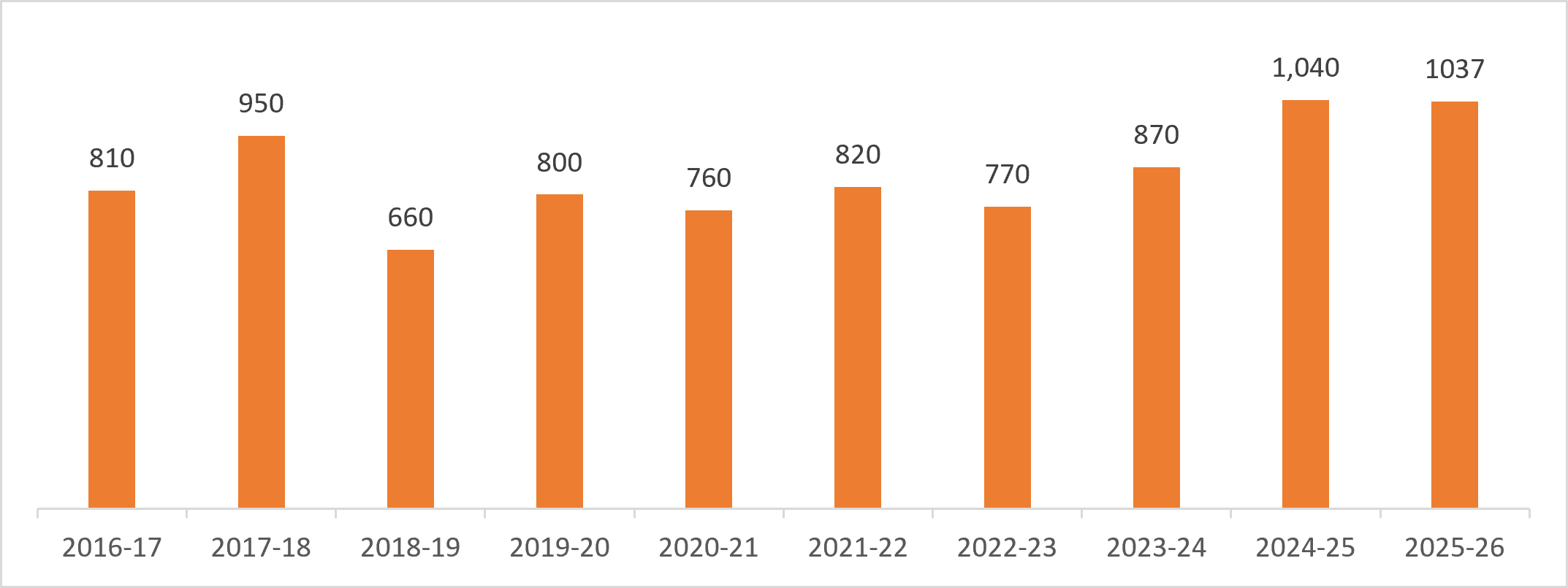
India is the second-largest tobacco producer after China. The country has around 0.49 million hectares of area under tobacco cultivation, with tobacco production estimated at 1,036.91 million kg in 2024-25. India produces various types of tobacco, including flue-cured Virginia (FCV), bidi, country, burley, rustica, hookah, cigar wrapper, cheroot, oriental and chewing tobacco. India’s tobacco and tobacco products are exported to markets across the globe, with exports reaching Rs. 18,044.30 crore (US$ 1.9 billion) over the latest reported period, reflecting a 166.51% increase in value over the past decade. India’s tobacco sector is a regulated and organised industry managed by the Tobacco Board, covering a wide value chain from cultivation to exports. The country produces diverse tobacco types and value-added products, reflecting strong product diversity.
Tobacco Production of India (million kg)
Source: Agriculture Statistics at a Glance Report
The sector contributes economically through domestic manufacturing and export earnings, supported by a formal registration system for stakeholders. Tobacco cultivation, processing, and trade activities are distributed across multiple states, indicating a broad geographical presence and a structured industry ecosystem. India's major tobacco-producing states are Uttar Pradesh, Maharashtra, Karnataka, Gujarat, Tamil Nadu, Bihar, Uttarakhand, Punjab, Madhya Pradesh and Haryana. In 2024-25, Uttar Pradesh accounted for around 48.57% of India's total tobacco production, followed by Maharashtra at 24.19% and Karnataka at 10.57%. Gujarat and Tamil Nadu accounted for 3.02% and 2.94%, respectively, while Bihar contributed 2.67% of the country's total tobacco production. The remaining major producing states accounted for smaller shares of total production.
Tobacco Export Trend
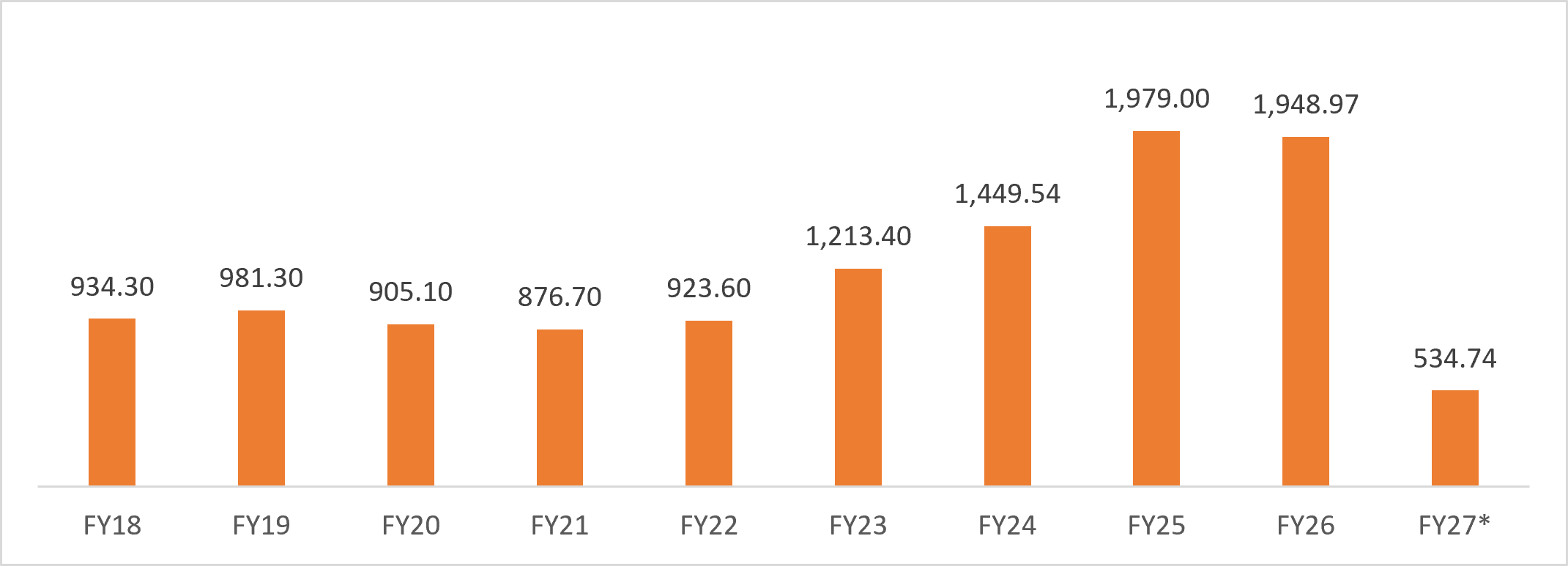
India Tobacco Exports (million US$)
Source: RBI, Directorate General of Commercial Intelligence and Statistics, NIRYAT
Note: FY27* - April to July 2026-27
India is one of the key exporters of tobacco and tobacco products, including manufactured and unmanufactured tobacco. The country exports a wide range of products such as cigarettes, cigars, smoking tobacco, homogenised tobacco, and unmanufactured tobacco across global markets.
India’s tobacco exports remained robust in FY26, with total exports reaching US$ 1,948.97 million, reflecting steady global demand across both raw and processed tobacco segments. Unmanufactured tobacco continued to dominate the export basket, contributing US$ 1,367.28 million, while manufactured tobacco exports stood at US$ 581.69 million during the period. The strong share of unmanufactured tobacco highlights India’s continued importance as a key supplier of raw tobacco to international processing and cigarette manufacturing markets. In volume terms, exports of unmanufactured tobacco reached 301.75 million kgs, underscoring sustained demand from overseas buyers across established and emerging markets.
The continued traction in manufactured tobacco exports also points to rising value addition within the sector, supported by processed tobacco products and branded offerings. Overall, the export trend reflects the sector’s resilience and India’s competitive positioning in the global tobacco trade.
India is the second largest exporter of tobacco behind Brazil. It exports various types of tobacco and tobacco products such as stripped, wholly stemmed, cigar cheroots, smoking tobacco, homogenised, flue-cured, sun-cured, extract and essence, FCV tobacco, unmanufactured tobacco, and various tobacco products.
Major Markets
India exports tobacco and tobacco products to a wide range of global markets, with key destinations including the United Arab Emirates (UAE), Belgium, the United States, Indonesia, France, Oman, Nepal, Singapore, Thailand and Saudi Arabia.
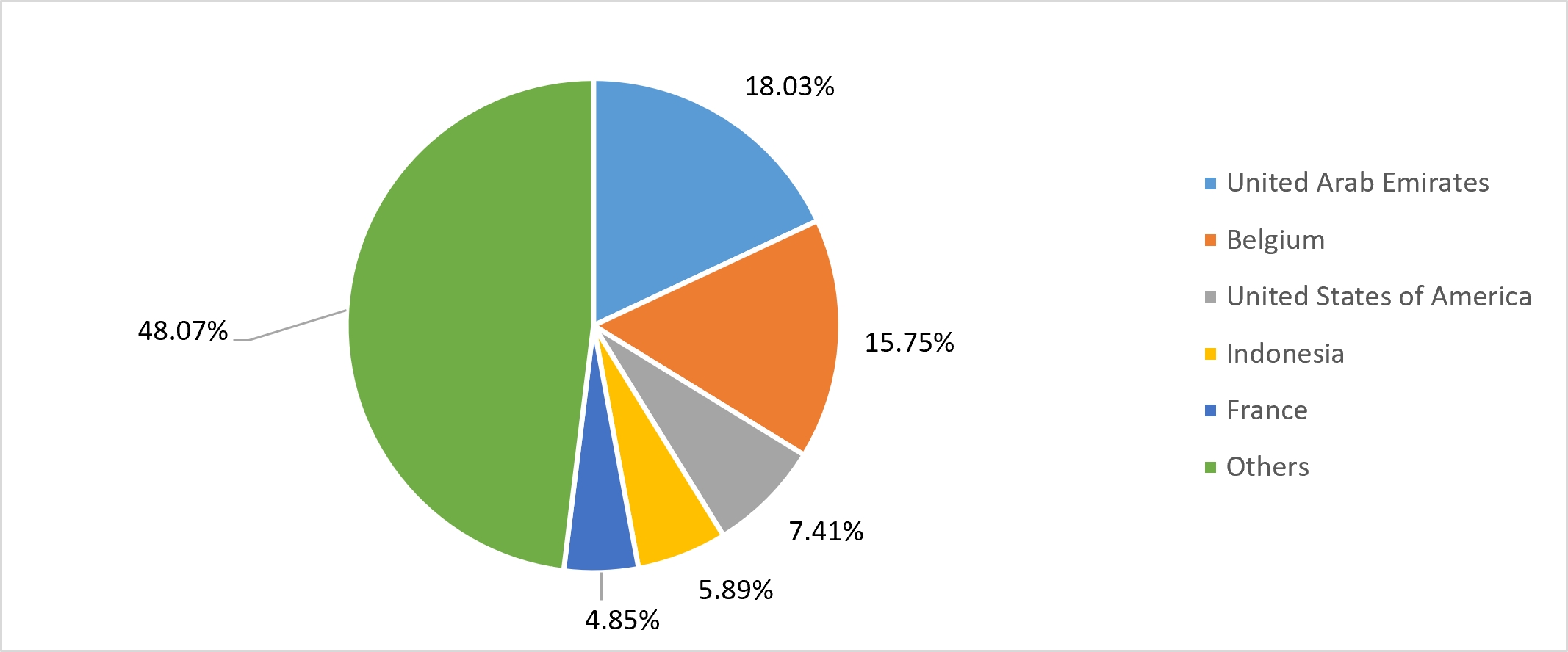
In Q1 FY27, the United Arab Emirates emerged as the largest destination for India’s tobacco exports, with exports valued at US$ 96.44 million, followed by Belgium (US$ 84.23 million). Other significant destinations included the United States of America (US$ 39.60 million), Indonesia (US$ 31.48 million), France (US$ 25.95 million), Oman (US$ 18.48 million), Nepal (US$ 17.38 million), Singapore (US$ 15.27 million), Thailand (US$ 14.45 million) and Saudi Arabia (US$ 13.55 million). Together, these top 10 destinations accounted for US$ 356.83 million in tobacco exports during Q1 FY27, reflecting India's diversified export presence across West Asia, Europe, Asia and North America.
Country-wise share of tobacco exports from India FY27 (APRIL - JULY)
Source: NIRYAT, Ministry of Commerce and Industry
India is the only country which produces tobacco in two seasons. It exports to over 120 countries throughout the world. The country exports tobacco mainly to UAE, Belgium, Indonesia, Egypt, USA, Turkey, Republic of Korea, Russian Federation and many more countries worldwide.
Government Initiatives
In 2022, the government of India approved the extension of the Interest Equalization Scheme (IES) till 2024. The rates for IES have been revised as 3% for MSMEs (tobacco products have MSME registration) and 2% for manufacturers and merchant exporters.
Duty Draw Back Scheme
The goal of the scheme is to cut the duty and tax chargeable on imported products that will be used to manufacture exported goods from India. Under this scheme, unmanufactured tobacco, cigars, cheroots, cigarettes, manufactured tobacco, products containing tobacco, reconstituted tobacco, nicotine, tobacco substitutes, etc. will receive a 0.15% drawback rate.
Interest Equalisation Scheme (IES)
The scheme originally came into effect in 2015 and has received an extension till 2024. The interest equalization will be provided pre- and post-shipment rupee export credit. As per the extension, the rates for IES will be 3% for MSMEs, and 2% for manufacturers and merchant exporters of 410 tariff-specified lines.
Tobacco Growers Welfare Scheme
The scheme is aimed at the welfare of the FCV tobacco growers and their dependent families. A Tobacco Board’s Growers’ Welfare Fund has been approved by the Ministry of Commerce and Industry of India under this scheme. The total corpus approved is Rs. 29.82 crore (US$ 3.14 million).
Governing Bodies
Tobacco Board
The Tobacco Board, a statutory body under the Ministry of Commerce and Industry established under the Tobacco Board Act, 1975, is headquartered in Guntur, Andhra Pradesh. It regulates the production and marketing of tobacco, particularly Flue-Cured Virginia (FCV) tobacco, while promoting exports and supporting tobacco growers and exporters. In 2026, the Board continued to oversee FCV tobacco auctions and grower registration, while advancing digital initiatives and AI-based grading of tobacco bales. The Government also reviewed the restructuring of the Tobacco Board, simplification of registration procedures and expansion of export markets for Indian tobacco.

FAQs
India exports a diverse range of tobacco, including flue-cured Virginia (FCV), sun-cured, cigar and cheroot, smoking, homogenised and unmanufactured tobacco. The source does not provide variety-wise export demand data, but unmanufactured tobacco remained the largest export segment in FY26.
The Tobacco Board of India regulates tobacco production and marketing, particularly FCV tobacco, while supporting growers and exporters. It oversees auctions, grower registration and export promotion, and is also advancing digital initiatives and AI-based grading to strengthen the organised tobacco export ecosystem.
Uttar Pradesh, Maharashtra and Karnataka are the leading tobacco-producing states. In 2024-25, Uttar Pradesh accounted for 48.57% of production, followed by Maharashtra at 24.19% and Karnataka at 10.57%, making these states important contributors to Indian tobacco exports.
FCV tobacco is a major variety produced in India and is specifically regulated by the Tobacco Board. The source does not provide separate FCV export values, but continued auctions, grower registration and market development for FCV support its role within India’s broader tobacco export ecosystem.
Tobacco auctions provide an organized mechanism for marketing tobacco, particularly FCV tobacco, and are overseen by the Tobacco Board. In 2026, the Board continued FCV tobacco auctions and grower registration, supporting a structured supply chain connecting tobacco cultivation with processing and exports.
The source does not provide specific information on international quality or traceability standards. However, India has a formal registration system for sector stakeholders, while the Tobacco Board is advancing digital initiatives and AI-based grading of tobacco bales to strengthen quality assessment and organized trade.
Indian tobacco exports are diversified across established and emerging markets. In Q1 FY27, Indonesia recorded US$ 31.48 million in exports, while Oman, Nepal, Singapore, Thailand and Saudi Arabia recorded US$ 18.48 million, US$ 17.38 million, US$ 15.27 million, US$ 14.45 million and US$ 13.55 million, respectively.
Technology is supporting India’s tobacco export ecosystem through digital initiatives and AI-based grading of tobacco bales. In 2026, the Tobacco Board continued advancing these initiatives alongside grower registration and auction systems, helping strengthen the organization and quality assessment of tobacco supplied for international markets.
Manufactured tobacco exports reached US$ 581.69 million in FY26, compared with US$ 1,367.28 million for unmanufactured tobacco. The continued contribution of manufactured tobacco, including processed and branded offerings, highlights growing value addition within India’s tobacco export basket.
India’s tobacco export market has a diversified global presence, with exports reaching US$ 1,948.97 million in FY26 and shipments to more than 120 countries. Continued export-market expansion, value addition, organized regulation and technology adoption are supporting the sector’s longer-term export ecosystem.
RELATED SITES

1 - G.T. Road, Srinivasarao Thota
Guntur - 522004
Andra Pradesh
India
Tel.:+91-863-2358399/2358499/2327550
Fax: +91-863-2354232
Email: info@indiantobacco.com
Website: https://tobaccoboard.com/indexeng.php
Partners


