Introduction
India’s textile and apparel industry is a large, diverse, and globally significant sector, playing a vital role in economic growth, employment generation, and export earnings. As one of the world’s leading textile exporters, it contributes substantially to merchandise exports, supported by a strong domestic market and an extensive MSME base. Export growth was recorded across more than 100 destinations, while textile and ready-made garment products were exported from 548 districts, reflecting the sector’s broad-based geographic footprint. Continued government support through PM MITRA, the PLI Scheme for Textiles, RODTEP, RoSCTL and the Export Promotion Mission, along with India’s expanding network of FTAs, is expected to further strengthen market access and the global competitiveness of Indian textile and apparel exporters.
India is among the world’s leading textile and apparel manufacturing countries, supported by a strong and integrated value chain spanning fibre, yarn, fabric and garments. The country has a strong raw-material base, including cotton, silk, wool and jute, along with capabilities in man-made fibres. India ranks first globally in cotton cultivation area, with around 11.48 million hectares under cotton, accounting for approximately 38% of the global cotton area. It is also the world’s second-largest producer and consumer of cotton. India is the only country cultivating all four recognised species of cotton, further strengthening its position across the global cotton value chain. The country also has significant capabilities in silk, denim and man-made fibre production, supporting a diversified textile and apparel manufacturing ecosystem.
The textile and apparel industry is a major contributor to the Indian economy, accounting for around 2% of GDP and approximately 11% of manufacturing GVA. It is also one of the country’s largest employment-generating sectors, providing direct employment to more than 45 million people, with significant participation of women and rural workers. India’s textile and apparel manufacturing base is geographically diversified, with major production and export clusters across states such as Tamil Nadu, Gujarat, Haryana, Maharashtra, Uttar Pradesh and Karnataka. In 2025–26, these six states were among the leading contributors to India’s textile, apparel and handicraft exports, with Tamil Nadu and Gujarat recording the highest export values.
Export Trend
Source: Ministry of Commerce Dashboard, Niryat
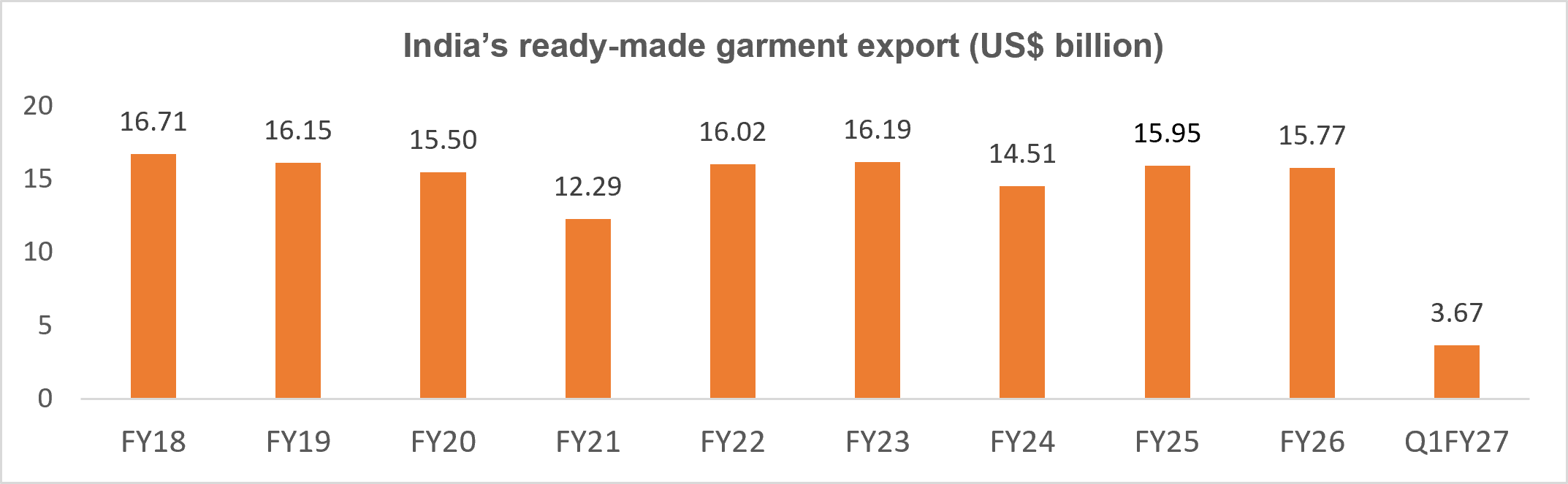
India is one of the leading exporters of ready-made garments (RMG) globally, supported by a strong manufacturing base and diversified product offerings. During FY26, India’s RMG exports demonstrated steady performance across key markets despite global demand fluctuations. India’s RMG exports stood at Rs. 1.39 lakh crore (US$ 15.77 billion) in FY26, while export during Q1 FY27 (April–June 2026) stood at Rs. 34,857.6 crore (US$ 3,670.38 million). For Q1 FY27 (April–June 2026), the RMG sub-sector composition was led by RMG cotton including accessories, which accounted for 61.34% of total RMG exports, followed by RMG of other textile materials at 20.52% and RMG manmade fibres at 16.34%.
RMG silk and RMG wool together accounted for the remaining 1.80% of the total. During 2026–27, Tamil Nadu was the leading state for RMG exports, accounting for 33% of total exports, followed by Uttar Pradesh (15.42%), Karnataka (13.69%), Haryana (12.71%), Maharashtra (6.59%) and Delhi (4.69%). Together, these six states contributed 86.10% of India’s RMG exports during the period.
India’s RMG export basket is dominated by cotton-based garments, with cotton T-shirts, cotton dresses, baby garments and other cotton apparel emerging among the leading exported products. Other major products include garments made from synthetic and man-made fibres, knitted shirts, nightdresses, jerseys and other ready-made garments, highlighting the diversity of India’s apparel export basket.
The government is targeting US$ 100 billion in textile exports by 2030 and US$ 600 billion by 2047. The roadmap for achieving this production and export target was set by Ministry of Textiles in its vision 2047.
Top Export Destinations
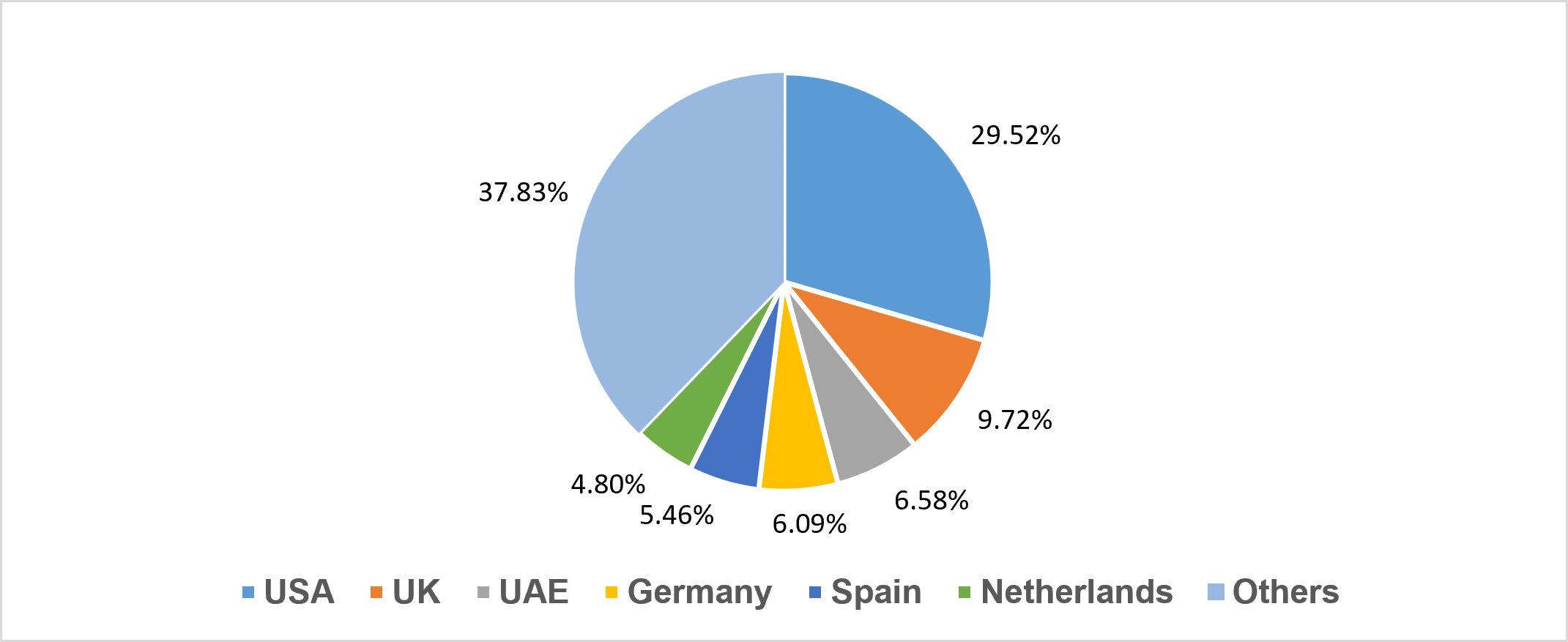
India’s RMG exports remain concentrated among a few key markets, with the USA continuing to dominate as the largest destination. In FY26, the USA accounted for 33.37% of India’s RMG exports, followed by the UK and UAE. In Q1 FY27 (April–June 2026), the USA remained the largest destination with exports of US$ 1,083.63 million, followed by the UK at US$ 356.62 million and the UAE at US$ 241.61 million. Germany, Spain, the Netherlands and France were also among the major destinations, highlighting the continued importance of the US, European and Middle Eastern markets in India’s RMG export basket. Mid-sized markets such as Saudi Arabia, Italy, and Poland also contribute steadily, though with relatively smaller export values of US$ 96.72 million, US$ 83.84 million and US$ 81.09 million, respectively. Overall, the export distribution reflects a balanced mix of developed economies and emerging markets, with strong dependence on the US and growing traction in Europe and the Middle East.
Country-wise RMG export share FY26
Source: Ministry of Commerce and Industry
This diversified geographical presence helps mitigate risks while providing opportunities for sustained export growth. Despite weakness in apparel exports, India's textile segment maintained positive momentum in Q1 FY27, with textile exports growing 5.19% year-on-year. Cotton textiles and man-made textiles also recorded growth, while handicrafts excluding handmade carpets registered particularly strong growth of 59.7% in June 2026, highlighting continued global demand across several segments of India's diversified textile export basket. RMG remained the largest component of India's textile and apparel exports, accounting for around 42.8% of the total in FY26. The sector also benefits from continued policy support through the RoSCTL scheme, while India's network of free trade agreements and focus on 40 priority markets is creating opportunities for greater market access and export diversification.
India has 16 Free Trade Agreements (FTAs) currently in force, providing preferential market access and opportunities for textile and apparel exporters across key international markets. The European Union remains a major opportunity, with its textile and apparel imports valued at US$ 263.5 billion in 2024. India and the EU successfully concluded FTA negotiations in January 2026, opening opportunities for zero-duty access across textile and apparel tariff lines and greater penetration of the large European market. The Government is also pursuing a focused export-promotion and market-diversification strategy covering 40 priority countries, while recent agreements with the UK, Oman, New Zealand and EFTA are expected to further strengthen market access for Indian textiles and apparel.
Government Initiatives
India’s apparel export sector is witnessing strong positive momentum, supported by a clear policy push and ambitious growth targets. The government is working on a comprehensive roadmap to scale textile and apparel exports from around US$ 40 billion to US$ 100 billion by 2030, with a focus on expanding into FTA markets, boosting high-value segments like handlooms, silk, and GI products, and converting non-exporting districts into export hubs. Complementing this, the Union Budget 2026 outlines an integrated approach to strengthen manufacturing, generate employment, and promote sustainability across the textile value chain, enhancing global competitiveness. Government initiatives such as PM MITRA Parks, Production Linked Incentive (PLI) Scheme, and skill development programs like SAMARTH are creating world-class infrastructure, encouraging large-scale apparel manufacturing, and improving workforce capabilities. Additionally, strategic trade agreements and policy support are opening access to major global markets, positioning India to significantly increase its share in global apparel trade and achieve long-term export growth.
As the textile industry is crucial for India’s growth, the government of India has implemented several schemes for the growth of production and ease of trade. The Amended Technology Upgradation Fund Scheme (ATUFS) and the Advance Authorization (AA) schemes are focused on strengthening and increasing the production of textile and apparel products in the country.
The Union Budget 2026–27 introduces a comprehensive strategy to strengthen India’s textile sector through fibre self-reliance, cluster modernisation, sustainable manufacturing, skilling, Mega Textile Parks and enhanced support for handloom and handicrafts. It also boosts exports and MSME liquidity through extended export obligation timelines, stronger TReDS financing mechanisms and Rs. 10,000 crore (US$ 1.09 billion) SME Growth Fund, aiming to position India as a global textile manufacturing and export hub while generating employment and promoting inclusive growth.
The National Technical Textiles Mission (NTTM) has continued to strengthen research, innovation and commercialisation in India's technical textiles sector. As of February 2026, 168 research projects had been approved under the Mission, along with three indigenous machinery development projects, 24 start-ups and support for 45 educational institutions to introduce technical-textile courses. The Mission has also facilitated 24 skilling courses, trained more than 1,000 people and empanelled 21 agencies for internship programmes. In February 2026, 16 additional research projects were approved in areas including advanced technical textile products, high-performance fibres, smart and functional textiles, protective gear, textile machinery and composite systems.
The Government has further strengthened support for innovation through the GREAT scheme, which aids young innovators, scientists, technologists and start-ups to translate technical-textile ideas into commercial technologies and products. For FY27, Rs. 2575.9 crore (US$ 271.24 million) has been allocated to the NTTM, including funding for start-ups under GREAT. By July 2026, 31 start-ups had been approved under the scheme at a total project cost of Rs. 154.9 crore (US$ 16.32 million), including Rs. 137.3 crore (US$ 14.46 million) as the Government of India's share.
Inspired by the Prime Minister Mr. Narendra Modi’s 5F Vision of Farm to Fibre to Factory to Fashion to Foreign, Bharat Tex 2026, India’s flagship global textile event, was held from July 14–17, 2026 at Bharat Mandapam, New Delhi. Organised by the Bharat Tex Trade Federation (BTTF) with the support of the Ministry of Textiles, the event showcased India’s complete textile value chain, covering fibres, yarns, fabrics, apparel and fashion, home textiles, technical textiles, handlooms, handicrafts and textile machinery. The event featured 1,647 exhibitors across more than 65,000 sq. metres of exhibition space and attracted 6,090 international buyers from 138 countries, along with nearly 95,000 business visitors. More than 29,000 structured B2B meetings were conducted, while over 40 MoUs were signed across trade, investment, technology, sustainability and institutional collaboration. The event also added 22 new buyer markets to India’s sourcing network and facilitated the onboarding of more than 500 new Indian exporters, further strengthening India’s position as a global textile and apparel sourcing and manufacturing hub.
Government Body
Apparel Export Promotion Council (AEPC)
The Apparel Export Promotion Council (AEPC), established in 1978, is the apex body for promoting India’s apparel exports and operates under the Government of India. It serves as a key link between exporters, international buyers, and the government, providing services such as market intelligence, policy support, and export facilitation. The council focuses on the export promotion of ready-made garments and supports the industry through research and inputs on free trade agreements (FTAs), foreign trade policy (FTP), and bilateral agreements. AEPC also organizes trade fairs, buyer–seller meets, and skill development initiatives to enhance the global competitiveness and positioning of India’s apparel industry.
AEPC has expanded its exporter-support activities through initiatives such as FTA-utilisation seminars, Niryat Samvad knowledge-sharing sessions, TRACE compliance support under the Export Promotion Mission, logistics and overseas-warehousing support, AI-enabled smart manufacturing initiatives and sustainability-related guidance.
FAQs
The USA remained the largest destination for India’s ready-made garment (RMG) exports, accounting for 33.37% in FY26. In Q1 FY27 (April–June 2026), exports to the USA reached US$ 1,083.63 million, followed by the UK at US$ 356.62 million and the UAE at US$ 241.61 million.
India’s apparel exports are led by cotton-based garments, including cotton T-shirts, cotton dresses, baby garments and other cotton apparel. The export basket also includes synthetic and man-made fibre garments, knitted shirts, nightdresses, jerseys and other ready-made garments, reflecting the diversity of India’s garment exports.
India’s RMG exports reached US$ 3,670.38 million in Q1 FY27 (April–June 2026), registering 11.3% growth over the corresponding period of FY24. RMG exports stood at US$ 15.77 billion in FY26, while the Q1 FY27 performance reflects continued growth in India’s apparel exports.
Government support for apparel exports includes PM MITRA Parks, the PLI Scheme, SAMARTH, RoSCTL, ATUFS, Advance Authorisation and the Export Promotion Mission. The Union Budget 2026–27 also focuses on sustainable manufacturing, cluster modernisation, skilling, Mega Textile Parks and stronger export support to enhance India’s garment manufacturing and exports.
Tamil Nadu, Uttar Pradesh, Karnataka, Haryana, Maharashtra and Delhi are major RMG export hubs. During 2026–27, Tamil Nadu accounted for 33% of RMG exports, followed by Uttar Pradesh, Karnataka, Haryana, Maharashtra and Delhi. Together, these six states contributed 86.10% of India’s RMG exports.
India’s 16 FTAs currently in force provide preferential market access for textile and apparel exporters. The India–EU FTA negotiations concluded in January 2026, creating opportunities for zero-duty access across textile and apparel tariff lines, while agreements with the UK, Oman, New Zealand and EFTA can support wider market penetration and clothing exports.
AEPC supports apparel exports by connecting exporters, international buyers and the government through market intelligence, policy inputs and export facilitation. It promotes ready-made garments through trade fairs, buyer-seller meets, skill development and FTA-related support, while also assisting exporters with compliance, logistics, smart manufacturing and sustainability.
Sustainability is becoming an important part of India’s apparel manufacturing and export strategy. The Union Budget 2026–27 emphasises sustainable manufacturing, while AEPC provides sustainability-related guidance. Government support for modernisation, innovation and technical textiles is also helping the textile export market adapt to evolving global requirements.
Indian garment exporters have opportunities to expand across FTA markets and 40 priority countries while diversifying beyond traditional destinations. Bharat Tex 2026 further strengthened these opportunities by attracting buyers from 138 countries, adding 22 new buyer markets and onboarding more than 500 Indian exporters into the global sourcing network.
India is targeting US$ 100 billion in textile exports by 2030, supported by expanded FTA access, high-value textile segments, export hubs, modern manufacturing infrastructure and skill development. With RMG remaining a major component of textile and apparel exports, these measures are expected to support further growth in garment exports and apparel manufacturing.
RELATED SITES

Apparel House, Institutional Area
Sector - 44,
Gurgaon - 122003,
Haryana,
India
Tel.: +91-124-2708000/ 03
Fax: +91-124-2708004
Email: chairman@aepcindia.com
Website: www.aepcindia.com
Partners


